Most glass looks much the same until something goes wrong.
Ordinary glass can break into large, sharp pieces capable of causing serious injury. That becomes particularly important where somebody could easily walk, fall or put an arm through a pane, such as in a glazed door or a low-level window.
This is why certain areas of glazing around a home deserve more attention than others.
Where Does Safety Glass Matter Most?
In England, Approved Document K to the Building Regulations identifies certain areas as critical locations because people are more likely to collide with the glass.
These include glazing in doors up to 1,500mm above floor level, glazing within 300mm of the side of a door up to the same height, and low-level glazing in walls or windows below 800mm from the floor.
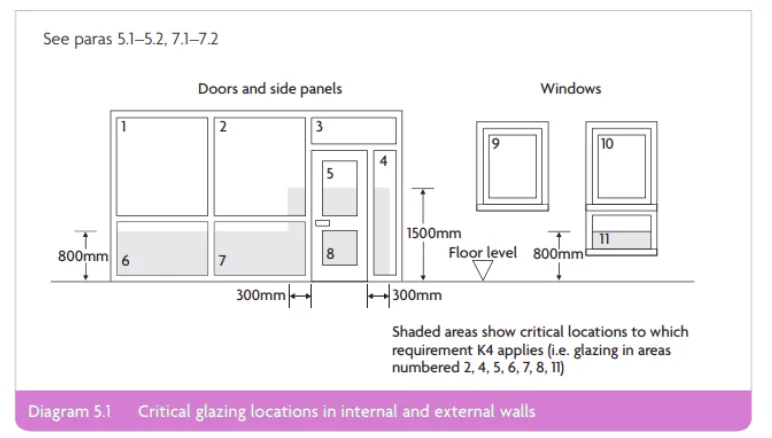
Approved Document K Diagram 5.1. The shaded areas show the critical glazing locations around doors and at low level.
That does not mean every pane in one of these locations must automatically be toughened glass. The regulations are concerned with reducing the risk of injury. Glazing can satisfy that objective by breaking safely, being sufficiently robust to resist impact, being divided into sufficiently small panes, or being permanently protected from somebody coming into contact with it.
For most modern homes, however, toughened or laminated safety glass is the solution people are most likely to encounter.
What Is Safety Glass?
Toughened glass has been specially heat treated to make it considerably stronger than ordinary annealed glass. If it does break, it is designed to disintegrate into relatively small pieces rather than the long, sharp shards normally associated with ordinary glass. Toughened safety glass is covered by the EN 12150 standards. The current British edition of the principal product standard is BS EN 12150-1:2015+A1:2019.
Laminated safety glass is constructed using layers of glass bonded together with an interlayer. When the glass breaks, that interlayer helps hold the broken pieces together rather than allowing them to fall away. This is also why laminated glass is commonly used where additional security or containment is useful. Current standards include BS EN ISO 12543-2:2021 for laminated safety glass, while EN 14449 is also commonly referenced in product markings.
There is also heat-soaked toughened glass, which undergoes an additional process intended to reduce the risk of spontaneous failure associated with certain inclusions within toughened glass. You may see EN 14179 referenced on this type of glazing. It is more commonly relevant to specialist or higher-risk applications than an ordinary domestic window.
How Can You Tell Whether Glass Is Safety Glass?
Look closely around the corners of the pane.
Safety glazing will commonly have a small permanent mark etched, printed or otherwise permanently applied to the glass. It can be surprisingly difficult to see, particularly against a bright background, so you may need to look from both sides or change the angle of the light.
The mark may include the manufacturer’s name or trademark, the relevant product standard and its impact classification. Common references include EN 12150 for toughened glass, EN 14449 for laminated glass and EN 14179 for heat-soaked toughened glass. The impact performance of safety glazing is commonly classified using BS EN 12600.
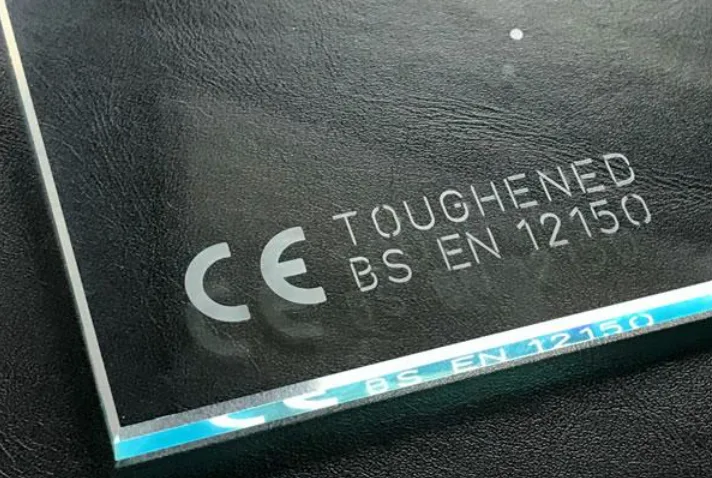
Example of a permanent EN 12150 marking. In an installed window or door the mark may be much smaller, fainter and positioned close to the corner of the pane.
A BSI Kitemark may also appear, but do not assume that a Kitemark is itself the requirement. Third-party certification schemes provide additional assurance but remain voluntary. The standard and classification shown on the glass are more useful when trying to establish what the pane actually is.
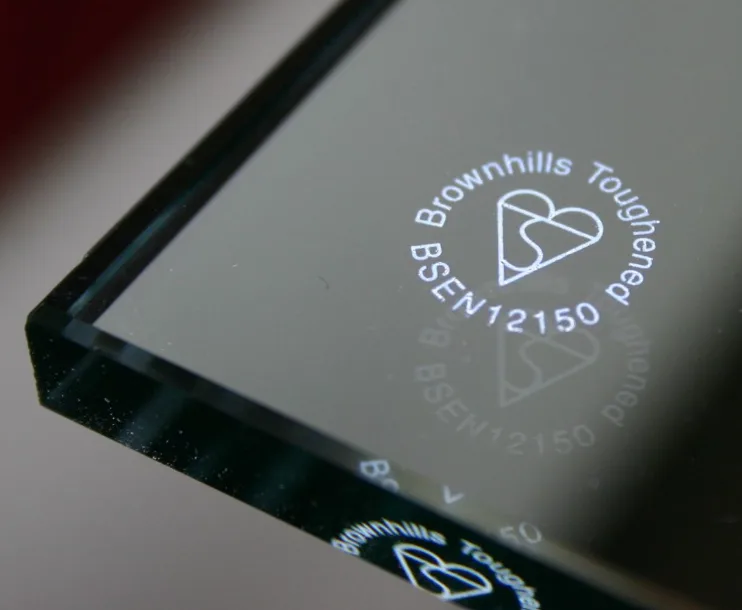
Older glazing may carry different markings from newer glass, so do not assume that every genuine safety-glass mark will look the same.
What if There Is No Mark?
This is where things become slightly more complicated.
An unmarked pane should not simply be described as unsafe. What you can reasonably say is that there is no visible evidence that it is safety glass.
Approved Document K also allows other methods of reducing the risk. For example, certain small panes of ordinary annealed glass can be acceptable. The guidance defines these as panes no more than 250mm wide, no greater than 0.5m² in area and generally at least 6mm thick. Traditional leaded or copper lights can be treated differently in certain circumstances.
Some sufficiently thick glazing can also achieve the required robustness without being conventional safety glass, and a permanent protective screen can be used to prevent somebody reaching the glazing at all.
The difficulty for a homeowner is that the type and thickness of an existing pane can be very difficult to establish just by looking at it.
So if you have a large, unmarked pane in a door, immediately alongside a door or very close to floor level, it is sensible to treat its safety performance as unknown rather than trying to guess what it is.
Can Existing Glass Be Made Safer Without Replacing It?
Potentially, yes.
Specialist clear safety film can sometimes be applied to existing glazing to improve its behaviour if the glass breaks. Properly specified filmed glass can be tested and classified to BS EN 12600.
However, sticking any clear plastic film onto a window does not automatically turn it into compliant safety glazing. The particular film and glazing combination needs to achieve the required performance, and safety film installed for this purpose should also be permanently marked to identify its classification.
This can make safety film a useful retrofit option where replacing an otherwise serviceable pane would be unnecessarily disruptive, but the product specification and installation matter.
What About Old Houses?
An old pane of glass does not become unlawful simply because today’s standards are different.
Older houses frequently contain glazing installed before modern safety requirements became commonplace, particularly in internal doors, entrance doors and low-level windows.
Building Regulations apply when relevant building work is carried out. Approved Document K itself distinguishes, for example, between replacing a complete frame and glazing unit and replacing glazing while retaining an existing frame.
That is separate from the practical question of safety.
A large sheet of ordinary glass in an old internal door can still present a greater injury risk today, regardless of when it was installed. If you find one, particularly in an area used regularly by children or where somebody could fall against it, upgrading the glazing may be sensible even where there is no regulatory requirement forcing you to do so.
If you’re viewing an older property, glazing is one of many visible elements worth paying attention to when you check a property’s condition before buying.
What Should You Do if You Are Unsure?
Do not try to test the glass by hitting it.
Start by looking carefully for a permanent mark, particularly in the corners. If one is present, photograph it because the information on the mark can help identify the type of glass.
If there is no mark, consider where the glass is located and the size of the pane. A small pane may be entirely different from a full-height sheet of unmarked glass in a door.
You may also have installation certificates, invoices or specifications confirming what was fitted. If there is still doubt and the glass is in a higher-risk location, a competent glazing contractor should be able to advise whether the existing arrangement is suitable and whether replacement glazing or an appropriate safety film would be sensible.
Knowing when something needs further professional investigation is an important part of understanding property condition. Survey Shack‘s guided property condition assessment helps homeowners and buyers identify what to look for, record what they find and understand when further advice may be appropriate.
The important thing is not to assume that every piece of unmarked glass is dangerous, but equally not to assume that glass is safe simply because it has been there for decades without an accident.
The Simple Rule
Pay particular attention to glass in doors, glass immediately beside doors and glass close to floor level.
Look for the permanent safety marking. If you can see one, record it. If you cannot, that does not automatically mean there is a defect, but for a large pane in one of these higher-risk locations it is worth establishing what protection is actually present.
Safety glass is one of those building details that most of us never notice.
Until we need it to do its job.